How to choose a signature scent for a hotel without sounding like every other hotel.
A working framework: brand voice in three adjectives, location in one sentence, and the one note you must avoid. Forty hotels later, here is what holds up.
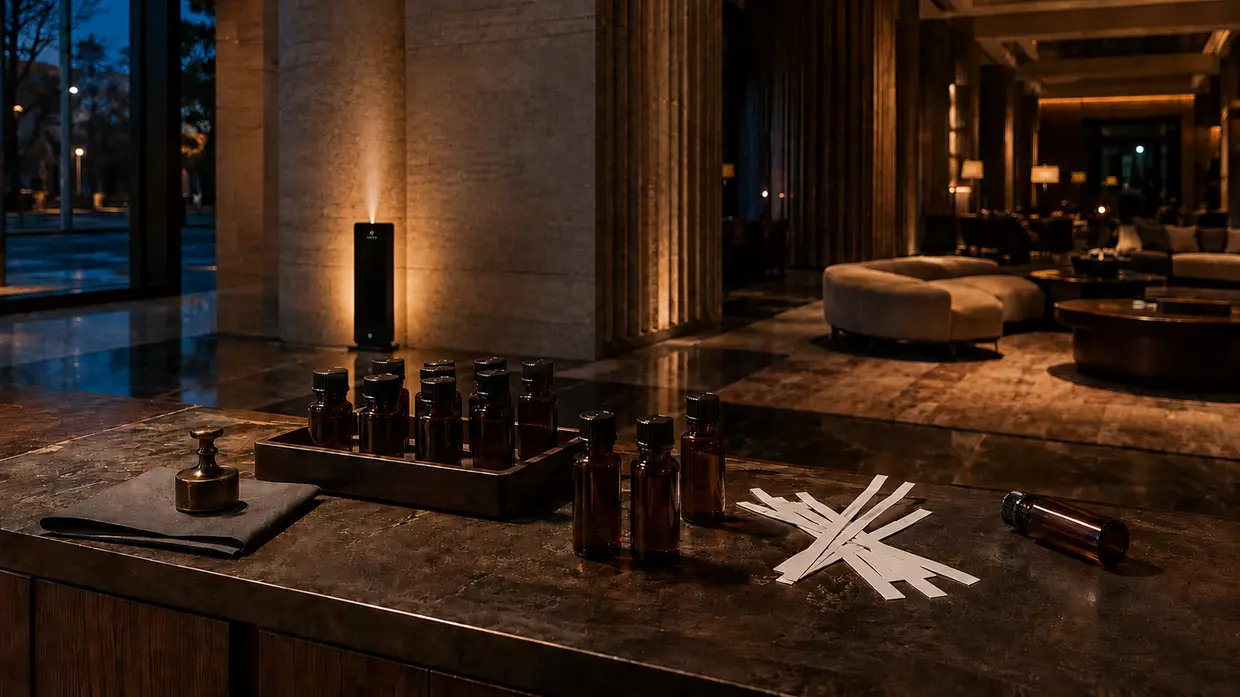
A hotel lobby smells of three things at once. The brand. The building. The brief.
A guest walks into a hotel lobby. They have eight seconds before their nose decides whether the place is worth the rate. In those eight seconds, three things compete for attention: the building, the brand, and whatever fragrance the GM signed off six months ago.
If the fragrance is generic, the brand loses. If it is overdone, the building loses. If it disagrees with the rate card, both lose.
This is the working framework we use after forty hotel installs across India. It is not a fragrance lecture. It is a brief-writing tool for the person who has to decide, defend, and renew the choice.
Why hotels smell the same
Most hotels smell of three notes. White tea. Bergamot. A vague woody base. The reason is structural, not lazy. The category-default fragrance was perfected by one global vendor in the late 2000s, then copied by every regional vendor that followed. It works. Guests do not complain. The brand becomes invisible.
Invisible is the failure mode. The point of a signature is not to avoid offence. The point is to be the smell guests remember when they think about whether to come back.
"Invisible is the failure mode. The point of a signature is to be the smell guests remember when they think about whether to come back."
Step 1 · Brand voice in three adjectives
Write three adjectives that describe the brand. Not the lobby. Not the bar. The brand. They must be specific enough to fail.
Examples that work:
- Confident, restrained, coastal.
- Heritage, warm, slightly austere.
- Sharp, modern, untropical.
Examples that fail:
- Premium, luxurious, refined.
- Welcoming, comfortable, memorable.
- Elegant, sophisticated, unique.
The failed examples describe every hotel in the world. The working examples eliminate at least seven of the twelve signatures in our library on the first read.
If your three adjectives could describe a competitor's hotel without changing a word, rewrite them. Your brief is not specific yet.
Step 2 · Location in one sentence
The signature has to honour the building, not fight it. Write one sentence about what the location *already* smells like before the system goes in.
Examples from real briefs:
Goa's sentence rules out tropical fragrances. The building already does tropical. A coconut signature would amplify a cliche.
Jaipur's sentence rules out cold, clean, modern signatures. They would fight the patina.
Mumbai's sentence is permission to do anything, because the building has nothing to defend.
Step 3 · The one note you must avoid
Every hotel has one fragrance family that should never enter the building. Write it down before you read any vendor's catalog.
This is the discipline that separates a serious brief from a drift toward the category default. Common ones we have seen:
- Coconut for any beach property serious about not feeling like a tourist resort.
- Lavender for any wellness property whose treatment oils already lead with it.
- Citrus opening for any property where guests dwell longer than ten minutes (citrus fades fast and reads cheap on the second hour).
- Sandalwood for any heritage Indian property that does not want to feel like a temple gift shop.
- Vanilla for any property that wants to be remembered as a hotel rather than a bakery.
The note-to-avoid is the most powerful filter in the brief. It eliminates 30 to 50 percent of vendor proposals without further conversation.
Step 4 · Shortlisting from the brief
With three adjectives, one location sentence, and one note to avoid, the shortlist writes itself. A library of 12 signatures usually narrows to three or four candidates. If it does not, the brief is still too vague.
Run each candidate against four operational questions:
- Does it project at low intensity? Lobby air turns over fast. The signature must hold at 18 percent diffuser output.
- Does it survive on the second hour? Top notes are seductive. Heart notes pay the rent.
- Does it work in the lift? A signature that overpowers a 1.6-square-metre cabin will overpower a corridor.
- Does it survive the breakfast buffet? If the lobby connects to F&B, the signature must hold against onion, butter, and coffee. Most do not.
The breakfast-buffet test eliminates roughly half of all "luxury hotel" fragrances on the market. They were designed for sealed European lobbies, not Indian properties with open dining.
Step 5 · Testing on the floor
Never select a signature by smelling a strip in a meeting room. The strip is concentrated. The room is not your lobby. The HR director sitting opposite is not a guest at 2 PM after a flight.
The working test:
- Run the candidate at 18 percent intensity for four hours in the actual lobby, before opening to guests.
- Walk in from outside, twice, fifteen minutes apart. Smell on entry, not on standing.
- Walk into the lift. Smell. Walk to the corridor on a guest floor. Smell.
- Stand in the lobby for forty minutes. The signature is correct if you forget about it after twenty.
The forty-minute test is the single most useful diagnostic. A correct signature recedes. A wrong signature insists.
Step 6 · Zone strategy
One signature is rarely the right answer for a whole property. Most hotels need two or three. The discipline is to make them feel like one family across zones.
A working zone map for a mid-sized hotel:
The mistake to avoid is using a different fragrance family in the spa than in the lobby. Guests notice the discontinuity. The hotel reads as confused.
Renewing the signature
A signature is not a one-time decision. Three things drift it over time: the staff, the season, and the building.
Staff lose their nose for it inside six weeks. They will swear the system is broken. It almost never is. They have stopped smelling what guests still smell on entry. This is olfactory fatigue, not failure.
The season changes the building's air. Monsoon adds humidity, which lifts heavy notes. Winter dries the air, which flattens them. The signature does not need to change. The intensity does, by 10 to 15 percent at the seasons.
The building changes too. Two years in, the carpet smells different. The HVAC has a new filter regime. The kitchen extracts have shifted. An annual fragrance audit catches these.
Summary checklist
Before you sign off on a signature, hold the brief against this list. If you cannot answer all eight, the choice is not ready.
- Three brand adjectives, each specific enough to fail.
- One sentence on what the building already smells of.
- One fragrance family that must not enter, written before reading any catalog.
- A shortlist of three to four signatures from the library.
- A four-hour test in the actual lobby at 18 percent.
- A forty-minute dwell test (does it recede?).
- A zone map across lobby, corridor, spa, and F&B.
- A signed renewal protocol for the first 12 months.
Eight checkboxes. Forty hotels of evidence behind them. Two-thirds of the briefs we walk into still skip three or more.
That gap is the opportunity. The signature is the only brand asset most hotels are still buying by accident.