Cold-air vs ultrasonic: why pros never use ultrasonic.
Particle size, oil dilution, and why your ultrasonic diffuser smells weak by lunchtime. The engineering case for cold-air diffusion in commercial spaces.
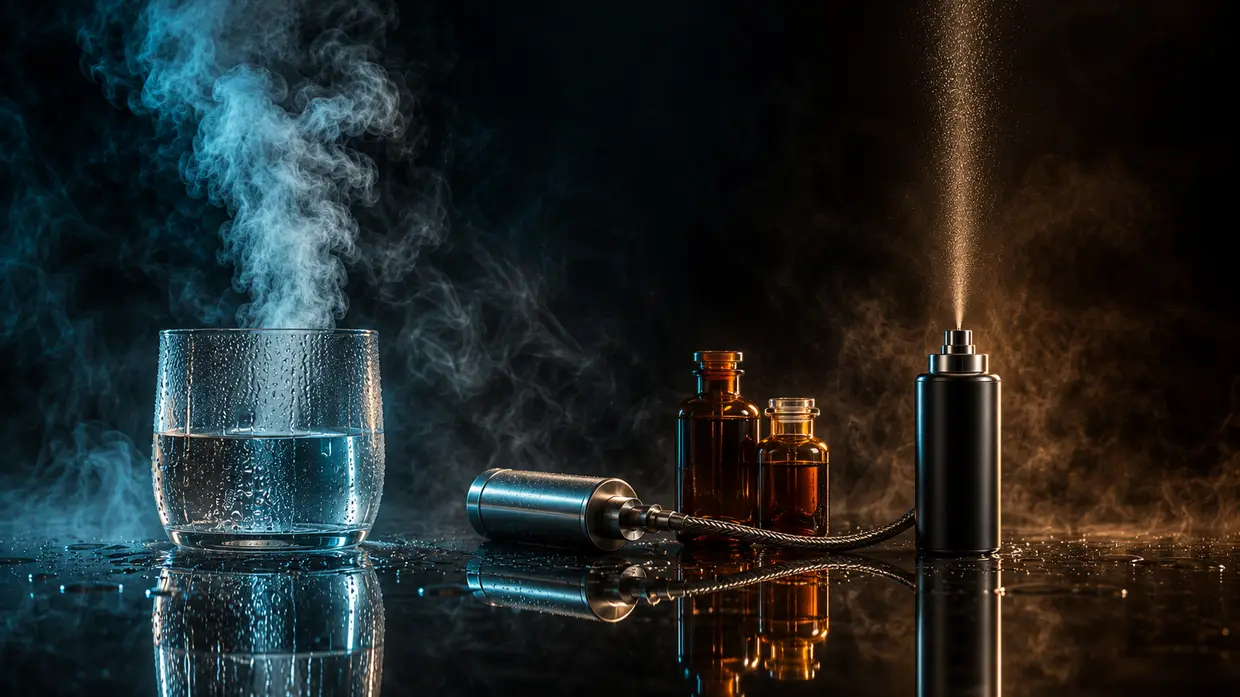
The ultrasonic diffuser is the consumer product. Cold-air is the infrastructure.
Every professional scent installation we have ever done uses cold-air diffusion. We have never installed an ultrasonic diffuser in a commercial space. This is not a commercial preference. It is an engineering conclusion reached after testing both categories in controlled conditions.
This is the honest technical comparison.
The mechanism difference
To understand why cold-air wins, you need to understand what each technology actually does.
Ultrasonic diffusers use a vibrating piezoelectric disc submerged in water. The vibration creates ultrasonic waves that shatter the water surface into a mist of micro-droplets. The essential oil or fragrance is mixed into the water reservoir. The resulting mist carries both water vapour and fragrance particles into the air.
Cold-air diffusers use a pressurised air pump to force air through a nebuliser nozzle. The nozzle atomises the fragrance concentrate (no water) into particles in the range of 1 to 5 microns. These particles are light enough to remain suspended in the air and travel with the existing airflow — HVAC, natural convection, or forced circulation.
The key word in that second description is concentrate. Cold-air diffusers use pure fragrance oil, undiluted. Ultrasonic diffusers use fragrance diluted in water.
Problem 1: Dilution
A typical ultrasonic diffuser reservoir holds 100 to 500 ml of water. The manufacturer recommends 3 to 10 drops of essential oil per fill. That is an oil concentration of 0.1 to 0.5%.
At 0.1 to 0.5% concentration, the diffusion output is mostly water vapour with trace fragrance. In a 15-square-metre room with no ventilation, that concentration may be perceptible. In a 200-square-metre retail floor with an active HVAC system pulling 6 to 8 air changes per hour, it disappears within thirty seconds of leaving the nozzle.
Cold-air diffusers use undiluted fragrance concentrate at 10 to 30% perfumer's concentration. The output is pure fragrance mist. The same air changes that destroy an ultrasonic signal carry a cold-air signal through the space.
Problem 2: Particle size
The ultrasonic process creates water droplets of 1 to 10 microns. The problem is the water. A 5-micron water droplet evaporates within 30 to 60 seconds at normal indoor humidity. As the water evaporates, the fragrance compounds bound to it also disperse — they do not stay suspended as free particles.
Cold-air atomisation creates dry fragrance particles of 1 to 5 microns directly. Without water, there is no evaporation collapse. The particles remain suspended and travel with the airstream. In a space with good air circulation, a cold-air particle can travel 10 to 15 metres from the diffusion point before settling.
This is the reason cold-air diffusion is specified for hotel lobbies with 6-metre ceilings. The particle reaches the ceiling zone. The ultrasonic mist does not.
Problem 3: Oil degradation
Ultrasonic diffusers require that the fragrance oil be mixed with water and sit in the reservoir, sometimes for days. Fragrance compounds — especially top notes built on citrus, aldehydes, and light florals — begin degrading in contact with water within 24 to 48 hours.
The practical effect: a reservoir filled on Monday smells sharp on Monday. By Thursday, the same reservoir smells flat, muted, and slightly stale. The staff have stopped noticing. The guests have not.
Cold-air diffusion draws directly from a sealed fragrance cartridge. The oil is not exposed to water or air until the moment of atomisation. A 250-ml cartridge in a cold-air unit has a consistent aromatic profile from first use to last drop.
Problem 4: Maintenance and scale
An ultrasonic unit with a 300-ml reservoir, running 8 hours per day at medium intensity, lasts approximately 6 to 8 hours before the reservoir is exhausted. For a single residential room, this is manageable. For a 20-outlet retail chain, this is a daily operational task per outlet — refill the reservoir, clean the disc (ultrasonic discs calcify with hard water), verify the output.
Cold-air diffuser cartridges at commercial concentration run 14 to 30 days depending on intensity and operating hours. The units have zero daily maintenance requirements. Remote fault monitoring is standard on IoT-enabled hardware. A pan-India retail rollout can be managed centrally with scheduled cartridge delivery.
Operational scalability is not incidental. It is why ultrasonic diffusion has never been adopted for commercial use by any serious operator. The labour economics do not work beyond a handful of units.
What ultrasonic diffusers are actually for
Ultrasonic diffusers are well-engineered for a specific context: a personal space of 10 to 20 square metres, with calm or no air movement, used intermittently, and cleaned regularly. A study room. A yoga corner. A small home office.
In that context, they work. The dilution and particle-size limitations are acceptable. The aesthetic — the mist plume, the quiet hum — is part of the product experience. They are not defective products. They are consumer products being used in the wrong context when installed commercially.
The problem is that they are priced accessibly and available everywhere, which means procurement teams sometimes specify them for commercial spaces where cold-air is the correct answer. The result is a system that performs adequately in the store manager's office and invisibly in the 400-square-metre trading floor they were asked to cover.
The heat diffuser case
A third category exists: heat diffusers, which use a warm plate or lamp element to volatilise fragrance oil. These are worse than ultrasonic for commercial use because heat alters the aromatic chemistry of the oil.
Fragrance is built from volatile organic compounds with different boiling points. The top notes — the first impression — have the lowest boiling points. Heat preferentially drives off the top notes first, leaving a progressively heavier, duller, and often sharper residual. A jasmine fragrance volatilised by heat for four hours smells like the base note of a jasmine fragrance — which is to say, it smells like something adjacent to jasmine but not like jasmine.
Cold-air nebulisation does not add energy to the oil. It mechanically atomises it. The aromatic profile of the oil in the cartridge is the aromatic profile in the air.
Specification summary
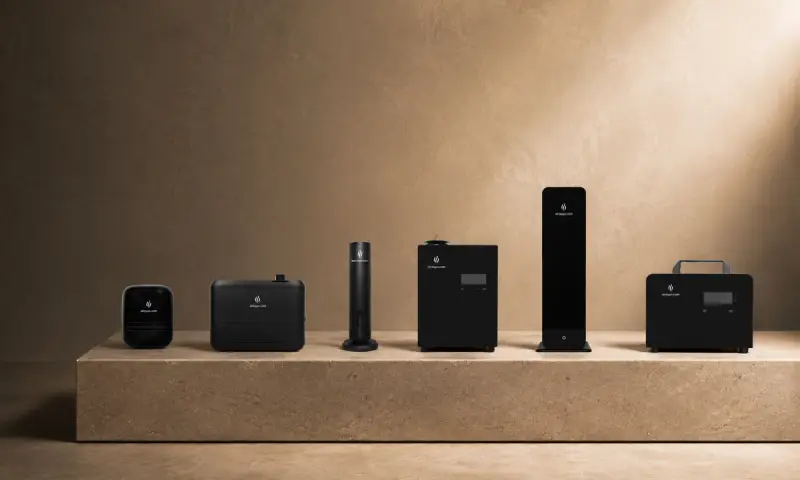
If you are evaluating diffusion hardware for a commercial space above 50 square metres, the specification is cold-air. The ultrasonic diffuser on the procurement list is a consumer product. The performance gap in your trading environment will be visible from day one.
Cold-air diffusers cost more. They cost more for the same reason a commercial kitchen range costs more than a domestic one: the engineering tolerances, the duty cycle, and the output consistency are different categories of product. The commercial case for fragrance in your space is hard enough to prove without a hardware choice that makes the fragrance invisible by lunchtime.